Sunday, July 6, 2008

Guts


Plane crashes, moose attacks, dogsled racing … These are just a few of the things you’ll read about in Gary Paulson’s autobiography Guts. Read on to find what real-life events inspired the fictional survival accounts of Brian Robeson in Paulson’s Hatchett series.

This is a must read for students and teachers who want to look more in depth with their favorite authors. There are so many incredible stories of daring adventures, your students won’t want to put it down. Watch time fly because you’ll be done with this book before you know it!

Paulson, G. (2001). Guts: The true stories behind Hatchet and the Brian books. New York: Delacourte Press.

Daniel's Ride

Read this book online at the following website:
http://www.childrenslibrary.org/icdl/BookPreview?bookid=prydnlr_00180001&route=simple_265_0_0_English_0&lang=English&msg=

Meet Daniel. He is just sitting down to breakfast with his family when all of the sudden, the walls start to vibrate and shake. What could be causing it? Is it an earthquake? No way! It’s the stereo system from his brother’s brand spanking new car! Daniel is about to get the ride of his life with the coolest brother in the world!

Sponsored by:
ICDL book logo
International Children's Digital Library
A Library for the World's Children

Please visit the International Children’s Digital Library. You can find it at www.childrenslibrary.org. Here, you can read thousands of storybooks and novels that have been translated into twenty-two different languages! It’s a breeze to find literature from any culture or country to support your social studies and language arts curriculum! Myths, folktales, true stories, children’s books, chapter books, poetry...this site has it all!

The Supernaturalist

http://www.fantasticfiction.co.uk/images/n12/n64423.jpg

In a world with no sponsors, noone has hope of a happy life. Cosmo should know. To the Orphanage where he lives, he's nothing more than a labrat. He has put all his energy into escaping only to be electrocuted and hurled to certain death. He’s a goner for sure.

Until they find him. Who are they? The supernaturalists. Dr. Ferdinand Bertoli’s genetic experiments that were created in his attempts to make superhumans. Bertoli, however, corrupted their DNA, resulting in a series of mutations. Mutations like ESP, slowed aging, and the ability to see microscopic parasites. Parasites that are infecting what’s left of the human population of satallite city.

This is a compelling book if you’re looking for a way to introduce students into the world of science fiction. It’s written by the same author of the Artemis Fowl series, and is sure to intrigue your students as they begin their venture into worlds entirely unlike their own.

Colfer, E. (2004). The Supernaturalists. New York: Hyperion Books for Children.

Saturday, July 5, 2008

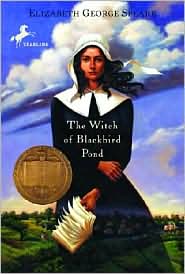
The Witch of Blackbird Pond

A Newberry Award Winning Book!


Hannah Tupper? A witch? Hardly! She's just a quaker, an outcast of society. Outcast or not, I still visit her all the time. Secretly of course. My name is Kit. I moved to Connecticut from Barbados to live with Goodwife Wood and her family. I'm not accustomed to their harsh ways of life, or all of these courtship practices. I even helped with the village school although my "heathen ways" stirred things up. Still, I manage. At least until a mysterious illness strikes the town and causes the crazed townspeople to go on a witch-hunt. Life as I know it is about to go up in smoke!


Set in the 1600s, when the
Puritan way of life reigned supreme, this piece of literature is an entertaining supplement to studies on early America. Students will identify with the plight of Kit and get a compassionate first-hand account of both the Puritan viewpoint, and the lives of those who forced to live outside of it.

Speare, Elizabeth. The witch of Blackbird Pond. New York: Houghton Mifflin.

Black and White

A boy on a train?


Parents dressed head to toe in newspaper?


A burglar hiding in a herd of Holstein cows?


Southern Rail regrets any inconvenience this may cause you.


What could these four stories possibly have to do with each other? Read David McCaulay’s Black and White to find out!
A Caldecott Award Winning Book!


Black and White weaves together four different stories so that the events that occur in one story affect the events and outcomes of the other three. Why not use this book to introduce making a timeline of events? Or introduce ecosystems by making a concept map showing how one character (or organism) affects the others?

These are just some of the many ideas from Carol Hurst's Children Literature site. Check out her other lesson plans and units connecting popular childrens' books to the classroom! http://www.carolhurst.com/titles/blackandwhite.html.

Macaulay, D. (1990). Black and white. Boston: Houghton Mifflin Company.

Thursday, July 3, 2008

Gathering The Sun

A Pura Belprie Award Winning Book!

M is for Mexico.

My grandparents came from Mexico.
My parents returned to Mexico.
My dream is to visit Mexico.


Y tu?


What's your dream?


Follow the lives of these young children as they take you into the heart of Mexican culture. With rich, vibrant pictures and poems in both english and spanish, you'll be able to see just what it's like to belong to a culture rich in tradition, family, language, and love. It's amazing that this book can take something as simple as learning the alphabet, and effortlessly turn it into a stepping stone for so many other things.

Keep the culture of your bilingual students alive in the classroom. Let them share this tale with you, their peers, or simply keep it around as a reminder of something familiar. Believe me, having bilingual books on hand goes a long way in reaching across the gap to meet the needs of students who have a harder time staying afloat.

Ada, A. F. (1994). Gathering the sun: An alphabet in English and Spanish. Trans. Rosa Zubizaretta. New York, NY: Lothrop, Lee, & Shepard Books.

Lon Po Po


A Caldecott Award Winning Book!
Please visit the following website for an accompanying cyber (online) lesson about Lon Po Po. Learn about the author, the country of China, compare Lon Po Po to the real Little Red Riding Hood story and much more!
http://publish.bsu.edu/00smtancock/CyberLessons/LonPoPo/

The image “http://www.vickiblackwell.com/lit/images/panelpics.jpg” cannot be displayed, because it contains errors.

The shadows of the evening stretch forth across the paste
l panorama to make the wolf eerily visible despite the darkness. Stalking across the shadows, he finds a home with three children who are all alone. The children are excited to see their Po Po (or grandmother), and invite him inside. Decieved by the cunning wolf, he promptly blows out the only light in the house. This isn't your typical red riding hood story. There's no adult around to save these three children. No, they must learn to think quick and fend for themselves to protect their lives and their home.

Have your students on the watch for the wolf who lurks in the shadows!

Ed Young (1989). Lon Po Po: A Red Riding Hood Story From China. New York: NY: Philomel Books.